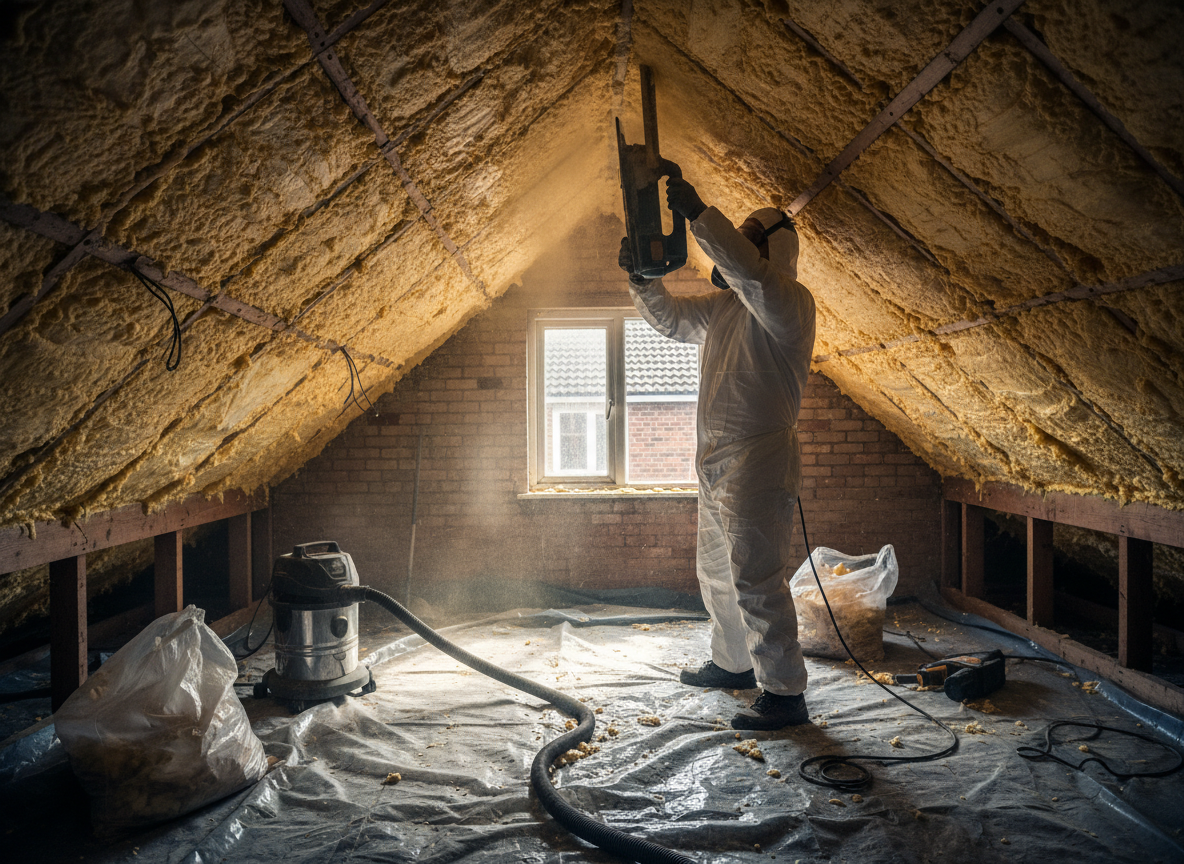
York's housing stock includes many Victorian terraces and Georgian properties where spray foam was applied to roof voids and ceilings in the 2000s. These installations often trap moisture because solid brick walls and narrow eaves prevent proper ventilation, especially during the frequent heavy rainfall that characterises the Vale of York. Removal requires careful cutting around original lath and plaster or timber joists to avoid structural damage that later shows as ceiling cracks or staining.
Polyurethane foam bonds tightly to timber and masonry, so technicians must use low-speed mechanical removal combined with manual scraping rather than aggressive solvents that could affect nearby electrical cabling or pipework common in pre-1919 homes. Dust containment is critical in terraced streets where party walls allow particles to travel into neighbouring lofts. All waste must be double-bagged and taken to licensed disposal sites; fly-tipping carries heavy penalties under local authority rules.
After extraction, voids are inspected for hidden rot or mould that developed because the foam prevented the roof from breathing. In properties near the River Ouse, rising damp can have wicked into floor joists once the foam is gone, requiring additional ventilation or membrane work. Homeowners should expect temporary loss of loft access and possible re-plastering where fixings were disturbed during removal.
Technician insight
In York, the thing that catches most people out with Residential Spray Foam Removal is how often foam was sprayed straight onto the underside of slate roofs in Victorian terraces near the city walls; once removed you discover the battens have started to rot because the foam stopped any airflow and the frequent drizzle has nowhere to escape.
Removal from a Bootham Terrace Loft
Homeowner in a late-1800s terrace off Bootham reported musty smells after heavy winter rain. Inspection showed foam had sealed the eaves and trapped condensation against the rafters. We cut the foam free in sections, cleared the blocked vents, and left the roof void open for natural drying before any new insulation was considered.
How it works
- 1
Initial Inspection
Survey the property to map foam depth, access points, and any signs of trapped moisture in York roof voids.
- 2
Site Preparation
Install dust barriers and floor protection to contain debris within the work area of the terraced or detached home.
- 3
Foam Extraction
Cut and peel foam in controlled sections, protecting original timbers and cabling during removal.
- 4
Clean-up and Disposal
Vacuum residues, bag all waste, and remove it to an approved facility while restoring access.
Pricing
Pricing varies by foam thickness, access difficulty, and disposal volume; we provide clear written quotes after inspection.