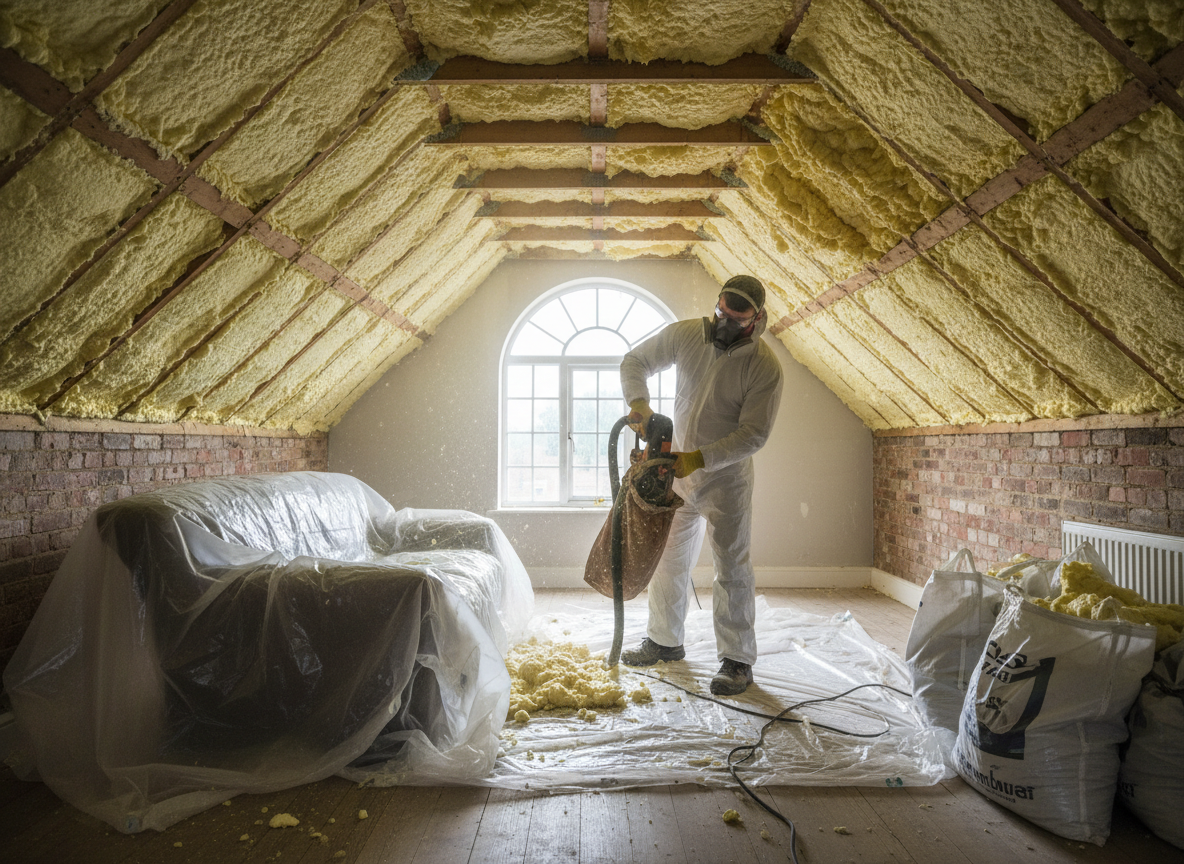
York's housing stock includes many Victorian terraces and Georgian townhouses where closed-cell spray foam was applied directly to rafters and lath ceilings in the 2000s. Over time the foam traps moisture against timber, leading to rot in the roof structure that only becomes visible once insulation is disturbed. Removal requires cutting the foam in controlled sections while supporting the ceiling from below to prevent collapse of fragile plasterwork common in these properties.
North Yorkshire weather adds another layer: frequent rain and high humidity mean any exposed roof membrane must be checked and repaired the same day. Leaving the loft open overnight risks water ingress into bedrooms below, especially on properties near the Ouse where flooding has affected ground levels in the past. Technicians therefore work with temporary weatherproofing and schedule around dry spells whenever possible.
Older stone buildings around the city centre often have uneven rafter spacing and hand-cut timbers that make standard foam cutters ineffective. Hand tools and low-speed routers are used instead to avoid scoring the wood, which would weaken the roof load-bearing capacity. Dust extraction is essential because historic properties frequently contain lime plaster that turns to fine powder when disturbed.
Technician insight
In York, the thing that catches most people out with loft spray foam removal is how the foam bonds to the original lath and plaster in Victorian terraces around the city centre. One wrong cut and the ceiling comes down; we always support from below and work slowly because those ceilings are often the only thing holding the structure together after decades of settlement.
Clifton Terrace Loft
Homeowner in a 1890s terrace near Clifton Green reported damp patches on bedroom ceilings. Inspection found closed-cell foam trapping condensation against rafters. We supported the plaster, removed the foam in sections over two days, treated surface mould on the timbers, and restored airflow with new soffit vents. The ceiling remained intact and the damp issue resolved.
How it works
- 1
Site Survey and Risk Assessment
Inspect the loft, identify foam type, check for timber rot, and confirm safe access routes through the property.
- 2
Containment and Protection
Seal off living areas with plastic sheeting and set up negative-pressure dust extraction to protect York homes with original plasterwork.
- 3
Sectional Foam Removal
Cut and remove foam in manageable pieces, supporting ceilings from below where lath and plaster is present.
- 4
Timber Inspection and Repair
Assess rafters for moisture damage, treat where needed, and advise on ventilation upgrades before new insulation is considered.
- 5
Clearance and Final Check
Remove all debris, vacuum thoroughly, and walk the homeowner through the cleared loft space.
Pricing
Cost depends on loft size, foam thickness, and access difficulty in older York properties; site visit required for accurate quote.