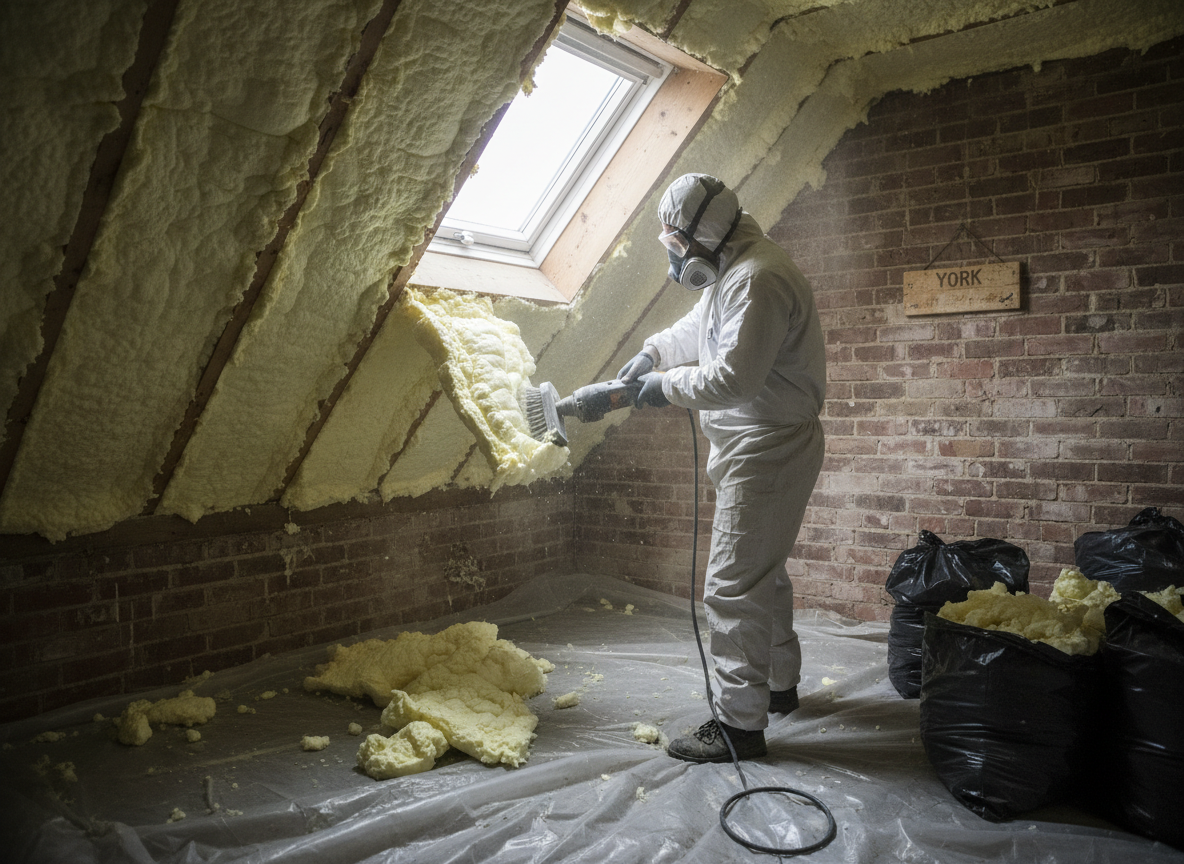
York's Victorian and Georgian terraces along streets like Micklegate and near the city walls often received open cell spray foam in lofts or wall cavities during the 2000s. The material expands and bonds tightly to porous brick and lime plaster, which is common in these buildings. Over time the foam can hold moisture against external walls, especially with the frequent rainfall and river Ouse flooding that affects the area. Removal requires mechanical scraping and vacuum extraction rather than solvents that could damage historic finishes. Workers must also check for hidden timber decay once the foam is gone, because the original insulation sometimes masked rot that now needs addressing before any new work begins.
Edge cases in the York area include properties with party walls shared between terraces where foam has crossed the boundary line. Extracting material from one side without disturbing the neighbour's structure demands slow, layered removal and temporary dust barriers. In flood-prone zones around the Ouse and Foss, any remaining foam residue must be fully cleared because trapped water can lead to mould regrowth within weeks of heavy rain. Older stone buildings near the Minster sometimes have irregular cavity depths, so technicians measure each section on site rather than assuming uniform thickness. Homeowners should expect the work to generate fine dust that needs HEPA filtration to protect both the crew and the interior finishes.
Local building practices in North Yorkshire mean many roofs have limited headroom and fragile lathe-and-plaster ceilings below. Cutting the foam in sections rather than pulling large sheets prevents ceiling damage. After extraction, ventilation gaps must be restored to meet current building standards for pitched roofs, particularly in properties that have had recent roof repairs. Leaving any foam behind near eaves or around chimneys can create cold spots that cause condensation on the remaining plaster. A final inspection with a moisture meter confirms the walls have returned to their pre-foam condition before the space is handed back.
Because York experiences long damp winters, any removal project should include a check for salt efflorescence on brickwork once the foam is gone. This indicates previous water penetration that the foam had hidden. Addressing the source, such as repointing or improving guttering, forms part of a proper job rather than simply clearing the insulation. Properties converted into flats often have added complexity with shared services running through the treated areas, requiring coordination so that electrical or plumbing runs are not disturbed during the process.
Technician insight
In York, the thing that catches most people out with open cell spray foam removal is how the material bonds into the porous brick of Victorian terraces near the Ouse, where winter damp makes full extraction slower and leaves behind hidden moisture pockets that only show once the foam is gone.
Removal from a Micklegate Terrace Loft
Problem: homeowner reported persistent damp smells in a 19th-century York terrace. We found: open cell foam trapping condensation against the external wall. What we did: sectioned removal with dust control followed by moisture checks and ventilation restoration. Outcome: walls dried out and the loft regained proper airflow without damage to original plasterwork.
How it works
- 1
Site Survey and Moisture Mapping
Technicians inspect the property, measure foam depth, and test wall moisture levels to plan safe removal routes.
- 2
Containment and Dust Control
Plastic sheeting and negative air machines protect living spaces while foam is cut into manageable sections.
- 3
Mechanical Extraction
Specialist tools scrape and vacuum the open cell foam from brick, timber and plaster surfaces without solvents.
- 4
Final Cleaning and Ventilation Check
All residue is removed, gaps are cleared, and airflow is verified before the area is returned to the owner.
Pricing
Cost depends on property age, foam thickness and access; upfront quotes provided after survey.