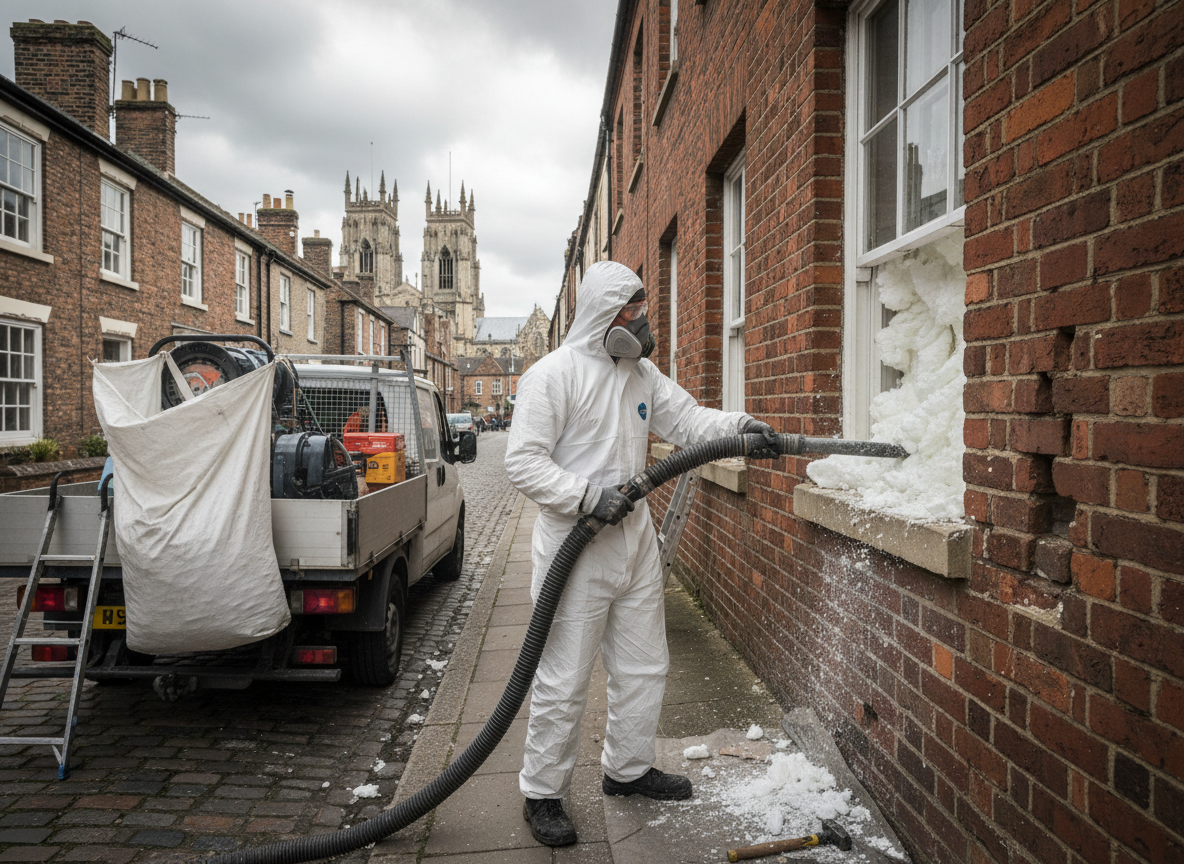
York's older terraced and semi-detached houses, many built before 1919 with narrow brick cavities, frequently suffer when spray foam was injected in the 2000s. The foam traps moisture against the inner leaf, especially during North Yorkshire's prolonged wet winters when driving rain penetrates stone and brickwork around the city walls and along the Ouse. Removal requires careful mechanical extraction to avoid dislodging loose mortar or original lath and plaster finishes common in these properties.
Edge cases arise in conservation areas and listed buildings where cavity access is restricted by timber lintels or party wall construction. Technicians must work from inside and outside simultaneously to prevent foam fragments migrating into neighbouring properties or blocking weep holes that already struggle with York's high water table. Incorrect removal can leave residue that continues to hold water, leading to recurring mould on internal walls.
Regulations in the York area require waste foam to be disposed of as controlled waste rather than general landfill. Homeowners often discover the original installation bypassed ventilation requirements, so part of the job includes reinstating airflow paths that modern building standards now demand. Working in confined roof voids above two-storey Victorian terraces demands dust containment and temporary weatherproofing during extraction.
Technician insight
In York, the thing that catches most people out with Cavity wall spray foam removal is how Victorian terraces around the city centre have very narrow cavities and soft lime mortar that the foam bonds to; one wrong pull after winter rains and you bring render or internal plaster down with it.
Foam Removal in a Micklegate Terrace
Homeowner in a 1890s terrace near Micklegate reported persistent damp on the gable wall after foam was injected years earlier. Inspection showed trapped moisture and blocked weep holes. We extracted the foam from both sides, cleared the cavities and restored ventilation. The wall dried out and internal mould stopped returning.
How it works
- 1
Site Assessment
Inspect cavity walls, check for moisture readings and map foam distribution in York properties.
- 2
Access and Containment
Create controlled entry points and seal work areas to protect interiors and neighbouring homes.
- 3
Foam Extraction
Remove foam mechanically while preserving brickwork and original features.
- 4
Clearance and Ventilation
Clear debris, reinstate weep holes and airflow paths to prevent future damp.
Pricing
Cost depends on property age, cavity depth and access restrictions typical of York terraces and listed buildings.